
A leaking outdoor faucet is a small repair in October and an expensive one in January. Water trapped in a compromised hose bib expands when it freezes, splitting the valve body or the supply line inside the wall.
At Justice Plumbing, we see the same handful of causes every fall in Granbury and across Hood County: a worn washer, a loose packing nut, or a failed vacuum breaker. All three are repairable. A leak coming from inside the wall is a different story, and it needs a plumber before that first freeze hits.
Why an Outdoor Faucet Leak Is a Freeze Problem
Water expands by roughly 9% when it freezes. That doesn’t sound like much until you realize a sealed valve body has nowhere for that extra volume to go. Something has to give, and it’s usually the metal.
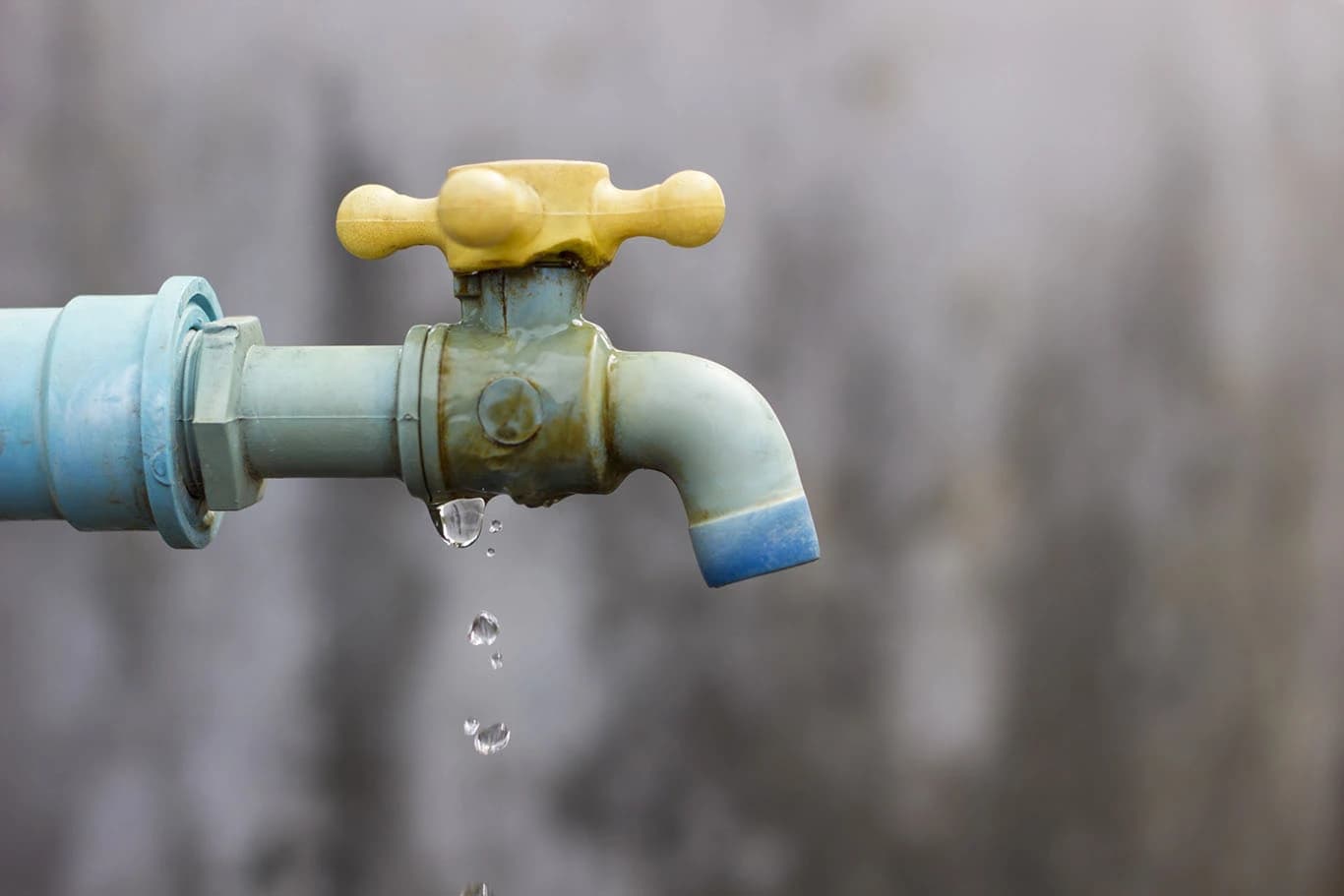
A hose bib that drips when it’s supposedly off isn’t sealing properly, which means water is sitting in the barrel instead of draining out. That standing water is exactly what turns into an ice plug on the first hard freeze.
Here’s what most homeowners don’t realize: leaving a hose connected traps water in the line even on a working frost-free bib. It’s the single most common reason frost-free faucets fail, and it has nothing to do with the faucet itself being defective.
North Texas freezes tend to be short and sharp rather than long and steady, which can actually work against homeowners here. Because deep, sustained cold isn’t the norm, a lot of local homes were built with less freeze-hardening than you’d find further north: exposed exterior lines, uninsulated crawl spaces, and wall runs that were never wrapped because nobody expected them to need it.
Where Outdoor Faucet Leaks Come From
Not every drip means the same thing. Here’s how to read what your faucet is telling you.
Water dripping from the spout when the handle is off
This usually points to a worn washer or a damaged valve seat. On a standard hose bib, this is typically a DIY fix. On a frost-free bib, it’s a different job entirely. The washer sits at the far end of a long stem that runs deep inside the wall, so replacing it means pulling the entire stem assembly, not just unscrewing a cap. It’s more involved than most people expect, and it’s where a lot of DIY attempts stall out halfway through.
Water leaking around the handle when it’s turned on
This is almost always a loose or worn packing nut. Often a quarter-turn with a wrench solves it on the spot.
Water spraying from the vacuum breaker or anti-siphon cap
That little cap on top of most outdoor faucets is a vacuum breaker, and Texas plumbing code requires it. If it’s spraying or leaking, the part itself has usually failed, and it’s typically an inexpensive replacement. What you shouldn’t do is remove it to stop the leak. It’s there to keep contaminated water from siphoning back into your home’s supply, and taking it off isn’t a workaround, it’s a code violation.
A crack in the faucet body
If you can see an actual crack in the metal, that’s freeze damage from a previous winter finally showing itself. This isn’t a repair. The faucet needs to be replaced.
Water appearing at the wall, foundation, or inside the house when the faucet runs
If you turn on an outdoor faucet and see water where it shouldn’t be, whether that’s at the exterior wall, the foundation, or inside the house, the supply line behind the wall has failed. Shut off the water and call a plumber for leak detection before you turn that faucet on again.
Low or no flow at the faucet
Weak flow or none at all can mean a partially frozen line, a previously split pipe restricting flow, or a stem that’s failed internally. Any of these is worth having looked at, since a partial freeze now often becomes a full split later.
Standard vs. Frost-Free Hose Bibs (and Why Frost-Free Ones Still Freeze)
A standard hose bib has its valve seat right at the wall face, which means the water sits in the exposed barrel section even after you shut it off. That’s why standard bibs are the most vulnerable to freezing.
A frost-free bib moves the valve seat 6 to 12 inches back into the wall, into warmer, conditioned space. When you shut it off, the barrel is supposed to drain completely, leaving nothing out in the cold to freeze.
So why do frost-free bibs still fail? Three reasons, and they’re all preventable:
- A hose is left attached, which blocks the barrel from draining even after the valve closes
- The bib was installed without the slight downward pitch it needs to drain by gravity
- The wall cavity it sits in isn’t insulated or heated the way it’s supposed to be
Frost-free is a real improvement over standard, but it’s not a guarantee. It still depends on being installed correctly and used correctly.
How to Winterize Your Outdoor Faucets
Do this before the first freeze warning shows up in the forecast, not the night of.
- Disconnect every hose, drain it fully, and store it somewhere protected
- Open each outdoor faucet all the way to let it drain, then close it again
- If your bib has an interior shutoff valve, close that valve, then open the outdoor faucet to let the line drain completely
- Install insulated covers on any standard, non-frost-free bibs
- Insulate exposed supply lines running through crawl spaces, garages, and any other unconditioned areas
- Fix any drip now. A bib that won’t seal properly can’t drain properly either, which defeats the whole point of frost-free design
Irrigation systems need their own winterization, separate from your hose bibs. Backflow preventers and above-ground manifolds are especially prone to cracking, and they don’t get the benefit of being tucked into a wall.
When to Repair A Leak Yourself and When to Call a Plumber
Some of these fixes are genuinely simple. Others aren’t, and pretending otherwise usually costs more in the end.
Reasonable to handle yourself: tightening a packing nut, replacing a washer on a standard (non-frost-free) bib, swapping a vacuum breaker cap, and installing faucet covers.
Call a plumber: frost-free stem replacement, any leak at the wall or inside it, a cracked faucet body, a line with no accessible shutoff valve, or if you can’t find the interior shutoff at all.
In Texas, plumbing work beyond a simple fixture repair is legally required to be done by a licensed plumber. Justice Plumbing has held license #37533 since 2001, and our technicians handle everything from a stuck packing nut to a full plumbing repair behind the wall.
Frequently Asked Questions
Why is my outdoor faucet dripping when it’s turned off?
Usually a worn washer or a damaged valve seat. On a standard bib, it’s often a straightforward fix. On a frost-free bib, the washer sits deep in the stem, so the repair involves more disassembly than people expect.
Can I leave a hose connected in winter?
No. A connected hose traps water in the line, which prevents even a frost-free bib from draining fully. That trapped water is what freezes, expands, and splits the valve or the line. This holds true regardless of how well the faucet itself is built.
How much does it cost to replace an outdoor faucet?
It depends on whether you’re replacing a standard bib or a frost-free one, and whether the supply line behind it is in good shape. Frost-free replacements generally cost more due to the extra labor involved in accessing the stem. We can give you an exact number once we’ve seen the faucet.
Do I need to cover my outdoor faucets in North Texas?
Yes, for standard bibs, insulated covers are cheap insurance against even a short freeze. For frost-free bibs on exterior or unconditioned walls, covers are still a good idea, even though they’re less critical than on standard faucets.
What is a vacuum breaker, and can I remove it?
It’s the anti-siphon device on top of most outdoor faucets, and it keeps water from siphoning backward into your home’s supply. Texas plumbing code requires it. Don’t remove it to solve a leak. Replace the part instead.
My outdoor faucet leaked all summer. Is that a problem?
Yes. A faucet that won’t seal in July won’t seal in December either, and that’s exactly the setup for a frozen, split line. A summer leak is next winter’s emergency call if it’s not addressed first.
How do I know if my hose bib is frost-free?
Look at the length of the faucet body extending from the wall and the angle of the handle. Frost-free bibs have a noticeably longer body (the stem runs deep into the wall) and the spout typically angles slightly downward to help drainage. Standard bibs are short and sit flush against the wall with no separate drainage feature.
Outdoor Faucet Repair and Freeze Protection in Granbury and North Texas
Justice Plumbing has been the plumber Granbury and Hood County call since 2001, and outdoor faucet repairs are some of the most common calls we get every fall. If a bib is dripping, spraying, or just not draining the way it should, getting it fixed now is a lot simpler than dealing with a split line in January.
If you haven’t had your plumbing looked at recently, a pre-winter plumbing inspection is a smart next step. It catches the kind of small issues, worn hose bibs included, before they turn into a freeze emergency. We also offer a plumbing protection plan for homeowners who’d rather not think about this every year.
Justice Plumbing serves Granbury and surrounding North Texas communities, license #37533. Contact us or call to get your outdoor faucets checked before the next freeze.

 All Service Areas